
26 August 2026
Kate Pilkington knows flow cytometry so well, she talks about it in her sleep, according to a friend who shared a room with her at a conference earlier this year. For someone who's spent 20 years immersed in the field, it checks out.
Kate leads the cytometry team at the Hugh Green Technology Centre, the Malaghan Institute's national centre of excellence for the field, where her team helps scientists deeply interrogate individual immune cells to understand health and disease at the most fundamental level.
So what is cytometry? The word comes from the Greek kytos, meaning ‘cell’, and metron, meaning ‘measure’. That's simply what it is: the measurement of cells. It starts with a sample of cells suspended in liquid. Those cells are labelled with tags that attach to specific proteins, chosen depending on what a scientist is trying to identify. The sample is then run through a flow cytometer, where the cells pass single file through a laser – thousands of cells per second. As each cell moves through, detectors read which tags have lit up and how brightly, and from that, the instrument builds a detailed profile of that individual cell: what type it is, what state it's in, what it's doing. Multiplied across hundreds of thousands of cells in a single sample, it adds up to a remarkably precise picture of what the immune system is actually doing, cell by cell.
That cellular detail underpins more than 85 percent of the Malaghan’s research and has been the focus of Kate’s whole career. It all began when she first sat in front of a flow cytometer during her honours year of a Bachelor of Science at the University of Adelaide.
The real joy of this work is the conjunction it creates,” Kate says. “World-leading scientists pushing the boundaries, backed by cutting-edge technology, thanks to the generous support of the Hugh Green Foundation. That combination of talent and resources doesn't come often.
“I realised early on that I thrive when expectation meets reality more often, rather than in the open-ended, slow grind of research. That's what drew me to flow cytometry: it's methodical, precise and it plays to my strengths. If I screw up a cytometry experiment, I know exactly what to troubleshoot, and there's an instant gratification of getting it right the next time.”
Cytometry was a very specific kind of problem-solving, one puzzle after another, each one solvable, that complemented exactly how her mind works. “It's like moving from kids puzzles to adult puzzles. A thousand pieces together to make a really big story.”
But what is that cytometry puzzle actually revealing? Most research findings start out as a theory, something scientists expect to be true based on other evidence, like a gene that looks like it should be active, or a treatment that should trigger a particular immune response. But a theory isn't proof. “It doesn't count until it's actually happening on or inside the cell,” Kate says. Flow cytometry is how researchers confirm whether that expected activity is genuinely taking place, turning a theory into a fact.
For Kate, the appeal of cytometry turned into a career almost by accident. She assigned herself the role of caretaking the university's flow cytometry instruments, and started spending her spare time tinkering with them, fixing small things, learning how they worked from the inside out. When the core facility leader at a neighbouring institute retired, she stepped right in. Looking back, it was the opportunity that set the direction for everything since.
From there Kate spent 14 years as a flow cytometrist at the Hanson Centre for Cancer Research and the Centre for Cancer Biology where, among other projects, she collaborated with researchers to diagnose blood cancers. In hindsight, it was the perfect training ground for where she is now: leading cytometry at the Malaghan Institute.
When Cytek Biosciences, the company behind the advanced cytometry equipment used in labs worldwide, came knocking in 2019, Kate made the leap from academia to industry. Even by then, with nearly two decades of expertise behind her, she found there was still more to learn. “I thought I knew flow cytometry before I worked at Cytek, but I was so wrong,” she says. “I learned exponentially greater skills while I worked there.”
Throughout Kate’s tenure at Cytek, the Malaghan was her most important client. In the late 2000s when Kate first heard of the Malaghan, Chief Technology Officer Kylie Price was already making waves in the cytometry community. Kate had her eye on a role at the Malaghan for years, but the timing never quite lined up. “I wish the stars would align so I could work at the Malaghan,” she remembers saying to Kylie. Not long after, an offer landed in her inbox. Kate didn't hesitate. Despite Wellington's inclement weather, she sold her house in Adelaide, packed up a life she'd spent nearly two decades building, and moved trans-Tasman. “It's not like I was an unknown, or the Malaghan wasn’t known to me,” she says. “We'd already been collaborating for years.”
As Kate settled into her role as Head of Cytometry, leading a team of five technicians, it brought her back to something that had been quietly building for years. During Covid, Kate found herself teaching cytometry classes online alongside her teammates. “I loved being able to tell a story that helps people learn,” she says. It was a turning point, because that discovery stemmed from Kate’s own learning experience in the industry.
When she first started learning flow cytometry, there was barely any formal training available, and almost nothing online. She learned largely alone, through trial, error and years of quiet self-doubt. “I'd been doing this for more than 17 years before I could walk into a room with cytometrists and not doubt whether or not I was a cytometrist,” she says.
So once she had the chance, she built the resource she never had. “I really wanted to set up an education pipeline, a structured curriculum that anybody could attend,” Kate says. The result, Grow Your Flow, now trains researchers from across New Zealand Australia and the United States. It's a special thing – a New Zealand institute setting the standard the rest of the world signs up for. “I want to prove that Wellington has some serious cytometry skills.”
None of it happens in isolation, either. “The real joy of this work is the conjunction it creates,” Kate says. “World-leading scientists pushing the boundaries, backed by cutting-edge technology, thanks to the generous support of the Hugh Green Foundation. That combination of talent and resources doesn't come often.” Now with Grow Your Flow in the mix, the Malaghan is well placed to guide the next generation of scientists.
Her own journey through the technology tells a similar story of quiet, steady growth. Her honours project ran a 3-colour flow cytometry panel – the combination of tags a cytometrist uses to identify characteristics of a cell. The more colours in a panel, the more you can identify on a single cell in one pass. By the end of her PhD, building 8-colour panels made Kate feel like “a rainbow wizard”. Today, her team routinely designs panels of 35–40 colours, with 60-colour panels now emerging in the field. When she started out, high-dimensional work was only available in a single laboratory in the world, and out of reach for almost everyone else. “Now this has become accessible,” she says.
That accessibility is what excites her most about where her field is headed. “The precision and detail we're getting now is really opening doors for personalised medicine,” she says. “Understanding each person's unique response to disease is becoming accessible to far more research institutes now, not just the handful who could once afford it.”
It's the same instinct that drew her to the technology in the first place, aimed now at something much bigger than herself. We’re no longer searching for a single answer for everyone, but the right answer for each person.
It's a fittingly grounded note from someone whose whole career has been built on getting a straight, honest answer out of a very complicated question. “Every question is a new puzzle. I love trying to work out what's not quite working and getting it to that point where it's just ... perfect. And then lining up the next puzzle.”
Support our life-saving research.
Donate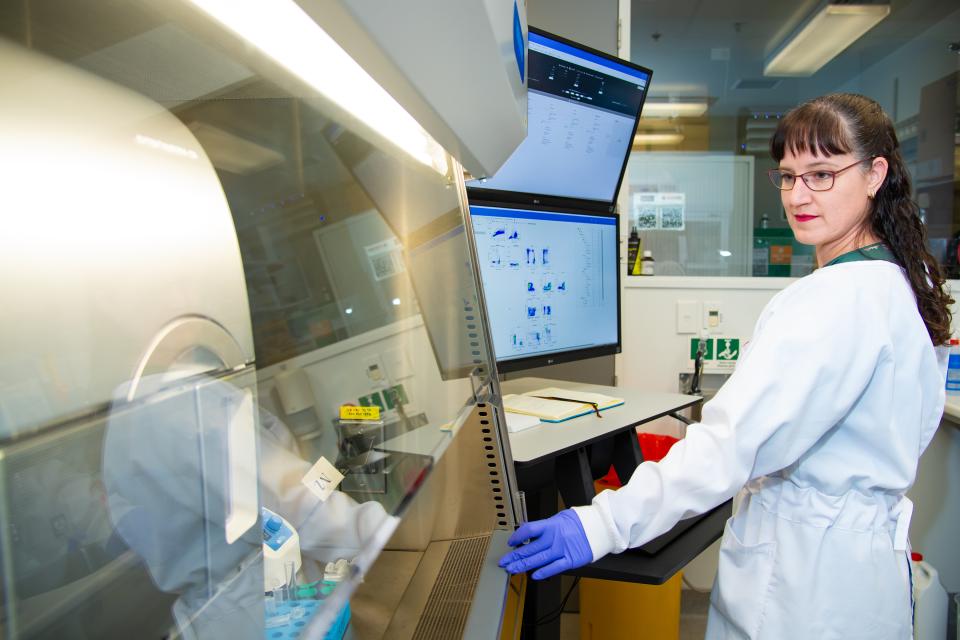
Related articles

New clinical research core to help take research from benchtop to bedside
8 September 2026

The evolution of one of humanity's oldest immunotherapies
27 May 2026

National RNA Development Platform hits milestone with 500 products made for human, plant and animal health research
16 April 2026

Celebrating milestones in bringing life-saving cell therapies to New Zealand
12 November 2025

Study explores wearable devices to improve blood cancer patient monitoring
8 October 2025

Blood, sweat and cells: The making of New Zealand’s first CAR T-cell trial
24 September 2025