
27 May 2026
Long before immunotherapy became one of the biggest frontiers in modern medicine, vaccines were already doing something extraordinary. They were teaching the immune system how to recognise danger, remember it and respond faster the next time it appeared. Vaccines are the original immunotherapy.

From left: Dr Lisa Connor, Dr Michelle Linterman and Prof Ian Hermans
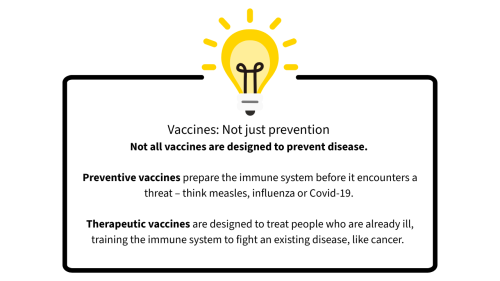
That idea has shaped decades of research at the Malaghan Institute. Today, scientists at the Malaghan are exploring RNA technologies, programmable vaccine platforms and human immune models that would have seemed impossible a generation ago. But the work is still built on the same central question researchers have been asking for years: how can we train the immune system more effectively?
For Professor Ian Hermans, the story stretches back to some of the institute’s earliest cancer immunotherapy research.
“When I started at the Malaghan, we were developing dendritic cell vaccines designed to train the immune system to recognise cancer,” says Prof Hermans. “Those early studies were really about understanding how you could direct immune responses in a very deliberate way.”
The work progressed into clinical trials for patients with many different types of cancer and helped establish some of the Malaghan Institute’s earliest translational research capability.
“That was really the beginning of building vaccine capability here,” he says. “We were developing the expertise, the facilities and the systems as we went.”
Years later, when Covid-19 emerged, that capability suddenly became critically important. In 2020, Vaccine Alliance Aotearoa New Zealand – Ohu Kaupare Huaketo (VAANZ) was established as part of the Government’s Covid-19 vaccine strategy to rapidly strengthen New Zealand’s vaccine development and manufacturing capability.
One of the most important aspects of VAANZ was the way it united researchers and manufacturers from the very beginning.
“One of the real strengths of the Vaccine Alliance was bringing commercial manufacturing and academic research together early,” says Prof Hermans. “It created a genuine development pipeline within New Zealand.”
VAANZ built the foundations for future RNA vaccine capability in New Zealand, but the science underpinning it had been building for decades.
“To the public, mRNA vaccines can feel like a completely new technology,” Prof Hermans says. “But researchers have been working with RNA-based therapies and vaccines in cancer for many years. Covid accelerated the field enormously, but the groundwork had already been developing for a long time.”
That momentum has continued beyond the pandemic. Today, the national RNA Development Platform is building directly on capability and investment established through VAANZ, producing RNA products for projects spanning cancer research, infectious disease, animal health and plant science.
For Malaghan Institute Director and Co-Director of the RNA Development Platform Professor Kjesten Wiig, the platform represents a major step forward for New Zealand science.
“The COVID-19 pandemic showed the world what RNA technology can do,” she says. “This platform is about making sure New Zealand does not get left behind. It is about building national capability and creating opportunities for new therapies and vaccines that can have real impact.”
The rapid growth of RNA technology has transformed what researchers can now ask of the immune system. One of the most exciting aspects is the ability to design vaccines with far greater precision than ever before.
“We can now use RNA technology almost like a design tool,” says Dr Lisa Connor. “It allows us to ask much more precise questions about how immune responses are formed and then build vaccines that shape those responses in very specific ways.”
Rather than vaccines being static interventions, they are becoming programmable tools for guiding the immune system with increasing precision. Researchers can now rapidly test how the immune system responds to different designs.
“With mRNA vaccines, we are no longer restricted to using a whole pathogen exactly as it exists in nature,” says Dr Connor. “We can identify the parts we think the immune system should target and then refine them further to make them even more effective at generating an immune response.”
Once encoded into the RNA sequence, the body’s own cells temporarily produce the target protein and present it to the immune system, allowing researchers to closely study the resulting immune response. The speed and adaptability of the platform means scientists can rapidly test new ideas and iterate designs much faster than with traditional vaccine technologies.
That flexibility is also opening new opportunities for collaboration across the Malaghan Institute. While Dr Connor’s team focuses on designing and refining vaccine technologies, Dr Michelle Linterman’s research explores how the immune system responds to vaccination at a cellular level. Together, the teams are investigating whether specific immune enhancing signals could be built directly into vaccines themselves, helping generate more targeted immune responses.
“When different groups bring complementary expertise together, you can move much more quickly from an idea through to testing,” says Dr Linterman. “That is really the vision for our next generation vaccines research.”
One example is the use of human organoid systems, laboratory grown models of human tissue that allow researchers to study immune responses in ways that are more directly relevant to human biology. These systems are now being integrated alongside traditional preclinical models to strengthen the connection between laboratory discovery and real world health outcomes.
“We want to make sure that what we are learning in the lab is as relevant to human biology as possible,” says Dr Linterman. “It is about having a strong bridge between discovery science and real world applications.”
And while RNA technology may represent the newest chapter in that story, it is still part of a much longer journey that began with some of immunology’s earliest ideas.
The next generation of vaccines is not a departure from traditional immunology, but a continuation of it, built on the same fundamental principles that have guided the field for centuries.
Support our life-saving research.
Donate
Related articles

New clinical research core to help take research from benchtop to bedside
8 September 2026

Research offers new approach to vaccine design for broader immunity
27 August 2026

Clinical study to uncover the origins of a severe type of Crohn’s disease
26 August 2026

Reading the immune system, one puzzle piece at a time
26 August 2026

Malaghan visiting researcher: Dr Lauren Holz
28 July 2026

Malaghan Institute to collaborate with IARC/WHO to reduce global burden of stomach cancer
24 July 2026