
27 May 2026
When New Zealanders were asked to support the Malaghan's ENABLE-2 CAR T-cell trial, the response was extraordinary. Supporters from across the country have helped close a critical funding gap and got in behind our efforts to bring CAR T-cell therapy to New Zealand. But what does this generous backing mean for our trial, and what’s next?

Dr Janice Cheng and Professor Rob Weinkove
With more than $1.4M raised through our CAR-T vs Cancer campaign and Go the Distance community fundraiser, supporters across New Zealand have helped fund our phase 2 clinical trial designed to confirm the effectiveness and safety of our CAR T-cell therapy and prepare the health system for routine delivery.
“As an independent medical research charity, our donors are critical to enabling us to run clinical trials and demonstrate new ways to bring advanced treatments into the New Zealand healthcare system,” says Clinical Director Professor Robert Weinkove.
“While significant philanthropic funding over the last two years made ENABLE-2 possible, the donations and collective support of everyday New Zealanders have made this truly a national endeavour. We are so grateful.”
The value of ENABLE-2
Now past its midway point, ENABLE-2 will cost more than $17 million to deliver – a cost that reflects the substantial overheads, such as clinical management and trial monitoring, that are no longer incurred when a treatment is delivered as standard care.
“When you consider that a single course of CAR T-cell therapy can cost as much as a million dollars overseas, the cost of treating 60 patients through ENABLE-2 starts to look very different. This investment not only treats 60 New Zealanders, but builds the capability to treat many more,” says Prof Weinkove.
“This trial is about breaking ground – building the systems, pathways and clinical expertise required to deliver CAR T-cell therapies in New Zealand.”
There is still work to be done. We expect to complete patient treatment by early 2027, with results then requiring analysis and peer-reviewed publication – a process that runs in parallel with regulatory review. These results will be critical in determining whether this specific CAR T-cell therapy moves beyond a clinical study. But we are now in a position where CAR T-cell therapy can be delivered in New Zealand, and where the experience gained is shaping how it can be used more widely.
Meanwhile, thanks to its safety profile, our CAR T-cell product is being prepared for investigation in paediatric leukaemia through a partnership between BioOra, our start-up company and manufacturing partner, and Cincinnati Children’s Hospital. This reflects growing international interest in this New Zealand-developed CAR T-cell therapy and its possible application beyond adult blood cancers.
Beyond ENABLE-2
If supported by results from ENABLE-2, we aim to move this form of CAR T-cell therapy beyond a clinical trial and into the New Zealand health system. That transition is already underway. Clinical and manufacturing data are being prepared to support regulatory review, while engagement with Medsafe, Pharmac and Health New Zealand is helping define how CAR T-cell therapies in general could be assessed, funded and delivered within our healthcare system – informed by what has been required to deliver it in practice.
“One of the key objectives of the ENABLE-2 trial is to support potential registration of this CAR T-cell therapy in New Zealand," says Prof Weinkove. "Subject to results and regulatory approvals and funding, our ambition is to see this therapy available through the public health system in 2027 – to limit gaps in treatment availability for those who need it.”
BioOra is leading this next phase, carrying forward the manufacturing capability developed through the trial and working with regulators and funders with the goal of delivering this therapy through the public health system affordably, at scale.
While our immediate priority is completing ENABLE-2 and the work required to take this therapy beyond the clinical trial setting, we are also laying the foundations for what comes next.
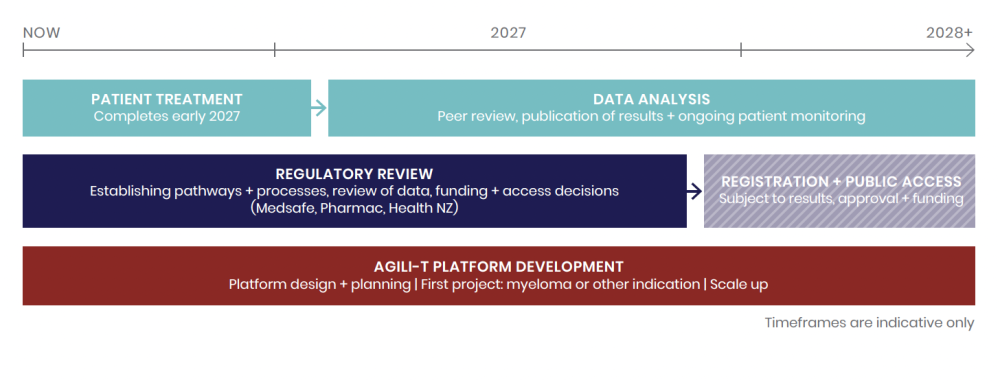
ENABLE and Agili-T timeline
Agili-T: a new way of working
The ENABLE clinical trial programme has established something that few centres worldwide can claim: the ability to take a new CAR T-cell therapy from early research through to GMP manufacture, clinical trial delivery, and potentially beyond. Building on this foundation, Prof Weinkove is developing a new platform to accelerate the development of new CAR T-cell therapies in New Zealand: Agili-T.
“Completing ENABLE-2 and successfully delivering our current CAR T-cell product for New Zealand would be a huge achievement,” says Prof Weinkove. “But current CAR T-cell therapies may only be the beginning of what immune cell engineering can achieve."
Agili-T will combine a structured approach to developing new CAR T-cell therapies, streamlined manufacturing and safety testing, adaptable phase 1 clinical trials, and real-time data integration to guide ongoing refinement.
Programme Manager Dr Janice Cheng says Agili-T represents a shift from delivering a single CAR T-cell clinical trial to establishing an ongoing, scalable model for developing multiple therapies, improving the speed at which advances are made.
“Our vision is to establish a world-leading centre for rapid early clinical development of CAR T-cell therapies, supporting both Malaghan-developed treatments and those of national and global collaborators.”
The first project for Agili-T will be determined by where the science is most ready to progress. This could include a potential new dual CAR T-cell therapy for myeloma currently in development at Malaghan, alongside opportunities to apply our existing CAR T-cell product to new disease settings or progress new collaborator-led candidates.Over time, the aim will be to scale up to test more therapies sequentially or simultaneously.
“With Agili-T, we’re designing the platform that could allow us to develop, assess and refine new CAR T-cell therapies within New Zealand more rapidly. This will be critical to expanding CAR T-cell therapies to new indications, such as other blood cancers, autoimmune disorders or solid cancers,” says Prof Weinkove.
“We've demonstrated that world-class CAR T-cell therapy can be developed and delivered here in New Zealand – now we want to build on that, so New Zealanders can be among the first in the world to benefit from the latest advances in the field.”
Support our life-saving research.
Donate
Related articles

Cancer: Same name, different diseases
23 September 2026

Malaghan Institute to collaborate with IARC/WHO to reduce global burden of stomach cancer
24 July 2026

Reading a tumour’s fingerprint for personalised immunotherapies
22 July 2026

Breakthrough Malaghan and University of Auckland cancer research advances into new biotech venture
16 June 2026

HRC funding to improve CAR T-cell ‘fitness’ and better fight cancer
11 June 2026

Researchers explore 'RENTAL CAR' approach to CAR T-cell therapy
21 May 2026