
24 June 2026
Dr Maia Brewerton (Ngāti Porou, Ngāti Kahungunu) is a clinical immunologist, immunopathologist, head of several immunology labs and also sits on the board of the Malaghan Institute. Based out of Auckland Hospital, she’s been working with patients with allergic and inflammatory conditions for over twenty years. Needless to say, she knows a thing or two about allergies and how to treat them.
Our understanding of allergies has come a long way in the past twenty years. The way we diagnose and treat these diseases has changed dramatically too. As someone who sits at both ends of the spectrum – from basic research all the way to clinical application – Maia is uniquely positioned to see first-hand what these changes mean not just for researchers, but for patients and their families, and where this exciting field of research is heading.
Changing preventions: avoidance versus exposure
“I’ve been in the field of immunology for more than two decades and one of the biggest paradigm shifts I’ve seen is in the food allergy space,” says Maia.
Food allergies and intolerances usually develop in early childhood and can range from mild to severe. It can be incredibly stressful for parents to know what to do to decrease the likelihood of their child developing a potentially life-threatening food allergy. No one wants to find out after it’s too late.
When Maia first started as a clinician, the conventional wisdom at the time was avoidance – remove any potential allergen, such as peanuts or dairy foods, from the diet to prevent the chance of developing an allergy. While founded in good logic – your immune system can’t react badly to something it hasn’t encountered – we now know that reasoning is flawed. In fact, it has subsequently been established that avoiding potential allergens in early childhood can increase a child’s risk of developing an allergy.
This about-turn wasn’t the result of doctors and researchers changing their minds, but the introduction of new research changing our understanding of how the immune system learns friend from foe.
“I remember it vividly,” Maia says. “I was at a clinical immunology conference in Australia in 2008 where I first heard of the potential importance of exposing the body’s immune system to food in the right way.
“It was Professor Gideon Lack, Professor of Paediatric Allergy at King's College London, who at the time presented the hypothesis that exposure to food allergens through the skin could be sensitising children to developing an allergy.”
Back then this approach to preventing allergies was still emerging so didn’t shift the needle immediately. Maia explains that it wasn’t until another key study came out in 2015, that things really began to change significantly.
“There was a landmark study establishing the importance of early introduction to peanuts in babies who were at high risk – not low risk – of developing food allergy,” says Maia.
“The study showed that introducing peanuts to infants in their first year of life – so between 4 and 11 months – reduced the risk of developing an allergy by 80%. That was the watershed moment when the guidelines changed to recommend introducing foods early rather than avoid them.”
It’s the immune system’s job to determine what’s safe – such as food – and what’s harmful: viruses, parasites, bacteria. But the work of many researchers showed that where in the body the immune system first encounters a food particle is important for teaching it whether it’s safe or not.
“We now know the skin is a critical route for sensitisation to food allergy. Much of that understanding has actually followed from research here at the Malaghan. Professor Franca Ronchese and her team have done important work identifying that dendritic cells, a unique population of immune cells that live in the skin and present things to the rest of the immune system, are constantly inclined towards sensitisation.
“Franca’s work showed that these cells are ‘primed’ to start down an allergy pathway, which is why it’s important not to put food on the skin for young babies, but to put food in the mouth.”
Changing treatments: suppressing versus targeting
The other big change Maia has seen in her time as a clinical immunologist is the approach to the way we treat allergies like eczema. She explains that at the time the way we treated an over-active immune system could be summed up in one word: suppression. “Like trying to crack a walnut with a sledgehammer.”
“We would use these very high-powered immunosuppressants to dampen down the immune system as a way to get control of what’s happening in the skin.”
However, widespread suppression is hardly a nuanced approach to a complicated disease like allergies. By removing or silencing the immune system in a vital organ like the skin, you’re also suppressing many other important functions the immune system needs to carry out to keep you healthy.
Thankfully, things have changed and today we see much more targeted approaches to atopic (skin) disease.
“We now see these really sophisticated treatments that get below the skin and target the immune and biological pathway that are driving the disease,” says Maia.
“Not everybody’s eczema is the same. So while the symptoms may seem similar on the surface, we’ve since learned that what’s happening below the skin can be vastly different. We now have treatments which target specific cytokines, which are proteins that act like messengers for the immune system, and block them to get a more localised effect.”
Changing horizons: from treatment to prevention
There’s a revolution in allergy treatment on the horizon. For decades, allergy research has been restricted largely because of technological limitations preventing researchers from understanding the fundamental principles between what makes one cell allergic and one cell not. Now, advancements are happening at record speed.
For Maia, she hasn’t seen this much optimism and excitement in the allergy space before.
“This is why I chose allergy and immunology. We’re seeing breakthroughs every year, every month. The more we understand about the immune system and what’s happening the more we can personalise and target medicines for patients in the future.”
The best allergy treatment is one where you don’t develop the allergy in the first place. The idea of preventing allergies is Maia’s ultimate goal.
“There are so many opportunities at the moment to get beyond just treating the symptoms and inflammation, so it’s an exciting time to be in research. We’re getting to ask the question not just how do we stop allergic disease, but how do we prevent it? How do we cure it?”
“There’s huge momentum in gene editing and RNA technology making headway with patients with peanut allergy.
“And of course, the more we understand about what’s happening under the skin, the better these kinds of treatments are going to get. Ultimately what I’d like to see in my time as a clinician is to prevent allergies from happening and hopefully put me out of a job!”
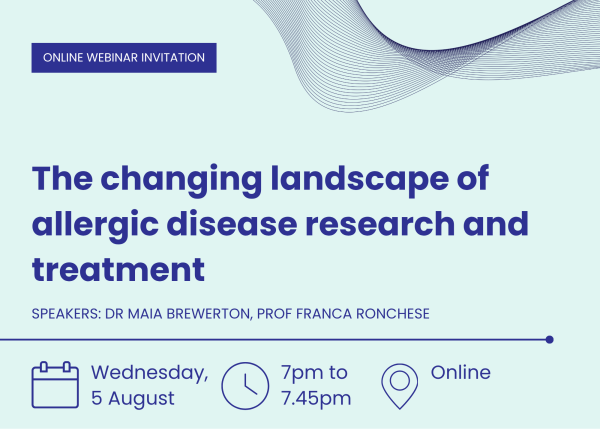
Join us for an in-depth conversation with world-leading allergy researcher Professor Franca Ronchese and clinical immunologist Dr Maia Brewerton about the changing landscape of allergic disease research.
Support our life-saving research.
Donate
Related articles

Cancer: Same name, different diseases
23 September 2026

Clinical study to uncover the origins of a severe type of Crohn’s disease
26 August 2026

Malaghan Institute to collaborate with IARC/WHO to reduce global burden of stomach cancer
24 July 2026

Reading a tumour’s fingerprint for personalised immunotherapies
22 July 2026

Fungal interactions in the lung and their impact on health and disease
27 May 2026

Building the RNA Development Platform, one RNA at a time
27 May 2026